
Verdict
The iPhone Duo appears remarkably polished for a first-generation foldable, especially in its hinge, display transitions and fold-aware software. A final score should wait for post-launch battery, durability and camera testing.
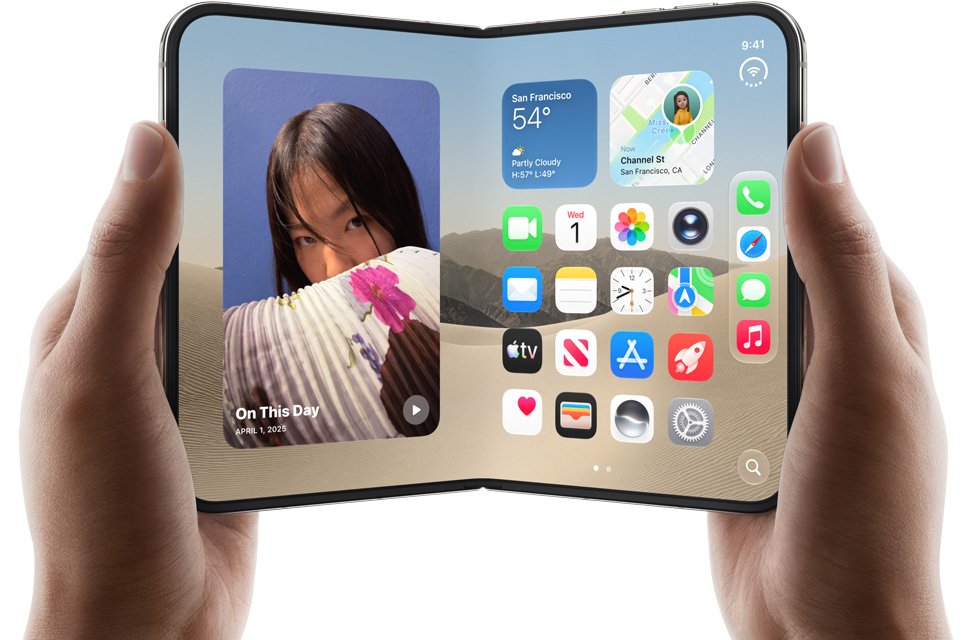
The iPhone Duo is not simply another expensive iPhone. It is Apple’s first foldable phone, so the more useful question is whether the company has created a form factor that feels like iOS was meant to fold rather than simply stretching an existing interface across a larger screen. Apple’s answer is a book-style design with a compact 5.4-inch outer display and a 7.6-inch inner display. When closed it is roughly passport-like; when opened it becomes a small tablet. The hardware is ambitious, but this review must carry an important qualification: iPhone Duo does not reach general availability until October 23, so PhonicSpecs is treating this as a detailed research-led review preview rather than a final long-term ownership verdict.
Design and hinge
Apple uses grade 5 titanium, Ceramic Shield 2 on the outer front surface and an IP68 rating. The hinge contains more than 100 components and is designed to hold the device at useful intermediate angles. At 254g, the Duo is heavy for a phone but not outrageous for a book-style foldable. Open thickness is only about 5.2mm, while the folded body is roughly 11.3mm thick.
Early hands-on reports from Tom’s Guide, TechRadar and The Verge have been positive about hinge feel, screen transitions and overall polish. Several reviewers noted that the crease is difficult to feel and less visually intrusive because of the inner display’s nano-texture treatment, although it can still be seen at certain angles and lighting conditions. That distinction matters: Apple appears to have reduced the problem, not abolished the physics of a folding display.
Two displays with a different philosophy
The 5.4-inch outer screen is intentionally compact. It is designed for normal phone tasks, quick replies, navigation and one-handed use. Open the Duo and the 7.6-inch panel provides a much wider canvas for reading, video, editing and multitasking. Both displays support ProMotion and Always-On functionality with high outdoor brightness. Apple also keeps their proportions closely related so content can transition without feeling like it has jumped to a completely different device.
The inner panel’s nano-texture finish is unusual for a phone. It reduces reflections and helps disguise the center fold, though buyers should understand that foldable screen surfaces are still fundamentally different from rigid cover glass. Apple says the inner construction uses multiple protective layers and structural support around the fold. Long-term scratch resistance, dust behavior and hinge wear still need months of real ownership evidence.
iOS 27 is the make-or-break feature
The Duo matters because Apple has redesigned parts of iOS rather than treating the inner panel as a stretched iPhone. Split View allows two apps side by side, users can save app pairs, run two windows of supported apps and move content between views. Interfaces can respond to fold angle, and StandBy can operate with the phone partially folded on a surface. Major apps are already adapting their layouts for the large canvas.
This is where Apple may have its strongest advantage over first-generation foldable hardware from years ago: the ecosystem already contains developers, tablet layouts and continuity features that can make the larger display useful. The risk is that not every third-party app will be optimized immediately. A $1,999 foldable should not be purchased solely on the promise that every app will eventually become excellent on the inner screen.
Performance and connectivity
A20 Pro powers the Duo, paired with Apple’s vapor-chamber thermal system and C2 cellular modem. The processor is the same generation used by the iPhone 18 Pro family, so raw performance is unlikely to be the weak point. The challenge is sustaining that performance while driving two displays inside a thinner folding chassis. Apple uses a dual-battery architecture, but it has not published a simple globally comparable mAh figure in the primary technical material PhonicSpecs is using, so we are deliberately not inventing one.
Wi-Fi 7, Bluetooth 6, Thread and eSIM support bring the connectivity package up to current flagship standards. Touch ID is integrated into the side button rather than using Face ID. That is a surprising departure for a modern iPhone, but it can make practical sense on a device that may be open, closed, flat on a desk or propped at an angle.
Cameras use the fold itself
The Duo uses a 48MP Fusion Main camera and 48MP Ultra Wide, with the main sensor providing an optical-quality 2x crop. On paper that is less ambitious than the triple-camera system of the 18 Pro, but the folding hardware enables shooting modes a normal phone cannot reproduce as naturally. The outer screen can act as a preview when the rear cameras are used for selfies, subjects can see framing while someone else takes the photo, and the device can prop itself up for hands-free video or group shots.
That makes the Duo camera system more interesting than its lens count. Buyers who need long optical zoom should still prefer a Pro flagship or specialized Android camera phone. Buyers who care about flexible framing, video calls and self-recording may find the foldable mechanics genuinely useful.
Battery, charging and the unanswered questions
Apple rates video playback at up to 44 hours using the outer display and up to 31 hours using the inner display, with typical-use claims around a full day. Fast wired charging can reach about 50% in roughly 20 minutes with a compatible high-output adapter, and MagSafe/Qi2 wireless charging reaches up to 25W. These are encouraging specifications, but a foldable’s battery behavior is heavily affected by how often the large inner display is used.
That is one reason this cannot yet be treated as a final long-term review. We need independent battery tests with mixed outer/inner-screen use, gaming, navigation, cellular data and standby. The same applies to hinge durability, inner-screen wear and app compatibility over time.
Price and who should consider it
At $1,999, the iPhone Duo is not a mainstream value purchase. It is aimed at early adopters, Apple ecosystem users who genuinely want a phone-tablet hybrid, mobile professionals who can benefit from two-app multitasking, and buyers who have been waiting specifically for a foldable iPhone. The price also creates obvious alternatives: a conventional iPhone Pro plus an iPad can cost a similar amount while avoiding first-generation foldable compromises.
Android foldables also have years of maturity behind them. Samsung and other manufacturers already offer refined multitasking, established repair programs and proven hinge generations. Apple’s advantage may be software cohesion and ecosystem integration; its disadvantage is that this is still version one.
Provisional verdict
Based on verified specifications and early independent hands-on reporting, the iPhone Duo looks unusually polished for a first-generation foldable. The hinge, nano-texture inner display, iOS 27 multitasking and camera preview modes show that Apple has designed around the fold rather than merely adding one. The $1,999 price and lack of long-term evidence are equally real. PhonicSpecs therefore recommends keeping this review in draft or clearly labeled preview status until post-launch battery, durability and camera testing is available. The final editorial score should be assigned only after that evidence exists.
Pros & Cons
Pros
- Polished first-generation foldable design
- 7.6-inch 120Hz inner display
- Useful 5.4-inch outer display
- A20 Pro performance
- Fold-aware iOS 27 multitasking
- IP68 protection
- Clever camera preview modes
Cons
- $1,999 starting price
- 254g weight
- First-generation durability questions
- No long-term battery data yet
- Less camera zoom than iPhone 18 Pro
- App optimization still developing
Frequently Asked Questions
When is the iPhone Duo available?
Apple says pre-orders begin October 16, 2026, with availability beginning October 23 in the first group of markets.
Does the iPhone Duo completely remove the display crease?
No. Early hands-on reports say the crease is less noticeable and difficult to feel, helped by the nano-texture inner surface, but it can still be visible at some angles and in some lighting.
Should I buy the iPhone Duo at launch?
It is best treated as an early-adopter product until independent long-term battery, hinge, inner-screen and repairability evidence becomes available.