
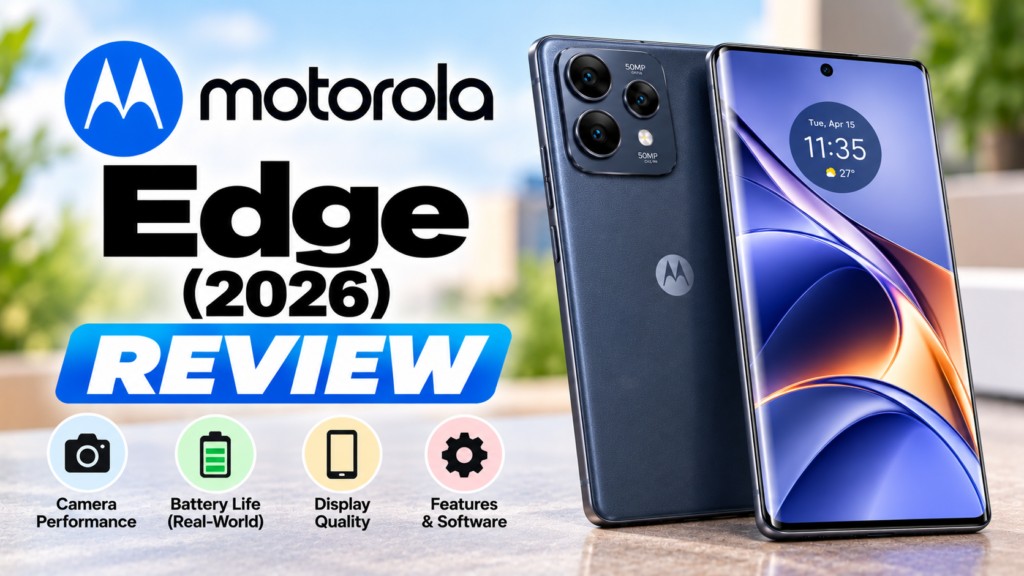
Verdict
The small 6.3-inch design and 3x optical camera make the Edge (2026) distinctive, but independently reported heat, modest speed and short updates undermine its original $600 value case.
The Motorola Edge (2026) has a combination many buyers keep asking for: a relatively compact 6.3-inch premium-looking display, serious water-resistance ratings and a dedicated 3x telephoto camera. At first glance it is an easy midrange shortlist candidate. The problem is price. At its US $600 launch level, independent reviews found weak performance for the money, heat under load, a short update commitment and some downgrades compared with the previous model. This is a phone to buy with a clear priority, not on specifications alone.
The 6.3-inch body is its most persuasive feature
The Edge (2026) is noticeably more manageable on paper than many 6.7-inch and 6.8-inch midrangers. Its AMOLED display uses 2640 × 1216 resolution, up to 120Hz refresh and rich HDR-capable colour, while the slim body is easier to pocket. Motorola advertises high peak brightness under specified display conditions, not a universal full-screen guarantee. Independent reviewers have praised the design and comfort. For readers tired of oversized phones, this ergonomic advantage may be valuable enough to prompt a shortlist—provided the device is not priced like a better-performing flagship.
Performance and heating: the uncomfortable compromise
The Dimensity 7450 handles normal messaging, streaming, maps and photography. However, independent longer-term evaluation found its performance weak relative to other $500–$700 alternatives, including elevated temperature during demanding workloads. Such testing does not mean every user will experience the same heat in every app, but it makes gaming and heavy video creation harder to recommend. The 8GB LPDDR5X RAM is adequate for common multitasking, yet the 128GB US storage baseline is tight for buyers recording a lot of video. A polished chassis cannot substitute for processing headroom.
Camera hardware is versatile but not foolproof
Motorola includes a stabilised 50MP main camera using a Sony LYTIA-family sensor, a 50MP ultrawide and a 10MP 3x telephoto. The dedicated telephoto is a meaningful advantage over phones relying entirely on digital cropping. But independent review coverage reported inconsistent results and weaker long-range zoom quality than the impressive camera list might suggest. For street photography, 3x is useful for portraits and details; for sports or distant landmarks, it is not the equal of stronger flagship periscopes. Buyers should compare sample photos at 1x, 3x and beyond rather than judging megapixel totals.
Battery, charging and durability
A 5,000mAh battery in a smaller device sounds promising, and 60W wired plus 15W wireless charging give practical flexibility. Motorola advertises IP68/IP69 resistance and military-standard testing. These are welcome for travel and everyday spills, but the ratings are not a warranty against every fall or liquid event. Wireless charging also depends on compatible pads, and real wired speeds require suitable equipment. Before buying an unlocked US device for another region, check band compatibility, supported SIM features and manufacturer warranty limitations.
Motorola Edge 2026 versus Edge 2025: not a straight upgrade
This is an unusual generation because a newer date does not guarantee more storage, better performance or faster charging. Reviewers identified reductions from the Edge (2025) in some important areas even as the 2026 model became more expensive at launch. Research the exact storage, camera, charging and service terms of each model being offered. If a 2025 unit is substantially cheaper and fits your needs, the 2026 badge alone is not a reason to switch. For similar money, also compare Pixel and Samsung alternatives with longer updates and better benchmark headroom.
Software and the ownership horizon
Motorola’s limited Android-upgrade and security-patch commitment is a material issue at its price. A phone bought in late 2026 should ideally remain safe and useful for several years; a relatively short guarantee undercuts the value of its durable body. The stock software has attractive gestures and familiar Android usability but independent reviewers criticised preinstalled promotional apps. Check the current Motorola policy by variant before publishing a precise end date, and assess how much the expected ownership period matters relative to the discounted selling price.
Edge (2026) versus a discounted Edge (2025)
The new Edge gains a more compact 6.3-inch design, but the older Edge (2025) started with 256GB storage and a 5,200mAh battery versus 128GB and 5,000mAh in the 2026 US model. The previous generation also offered 68W wired charging rather than 60W. That makes the newer date less meaningful than the exact current price, battery wear, screen preference and storage you need.
Android Authority’s independent hands-on and stress testing reported weak speed for the original $600 MSRP and substantial heat under heavier use. It also found inconsistent zoom-camera results despite the 3x optical lens. A discount helps the value calculation but does not change the hardware or software-update commitment; compare real alternatives rather than interpreting this as a flagship-equivalent device.
Sources
Pros & Cons
Pros
- Comfortable 6.3-inch 120Hz AMOLED
- 3x optical telephoto plus ultrawide
- 60W wired and 15W wireless charging
- Slim IP68/IP69-rated design
Cons
- Weak performance for launch price in independent testing
- Heat reported under prolonged load
- Short software update commitment
- 128GB US baseline and generational compromises
Frequently Asked Questions
Does Motorola Edge (2026) have optical zoom?
Yes. Motorola documents a dedicated 10MP 3x optical telephoto alongside its 50MP main and ultrawide cameras. Image quality at long zoom remains limited by sensor and processing.
Does the Motorola Edge (2026) get hot or perform poorly?
Android Authority’s independent review reported weak comparative performance and substantial heat during demanding use. That is third-party testing, not a PhonicSpecs laboratory result, and every workload differs.
Is Edge (2026) better than Edge (2025)?
Not in every respect. The 2026 model is more compact but starts at 128GB rather than 256GB, has a 5,000mAh rather than 5,200mAh battery and offers 60W rather than 68W wired charging in the documented US models.