The quickest way to check: Find your phone’s IMEI by dialing *#06#, then enter it into T-Mobile’s official phone compatibility checker. If you are buying a phone, also verify its exact regional model and network specifications before paying.
This 2026 guide explains those checks, compares verified smartphone specifications, and shows why two versions of the same phone can behave differently on T-Mobile.
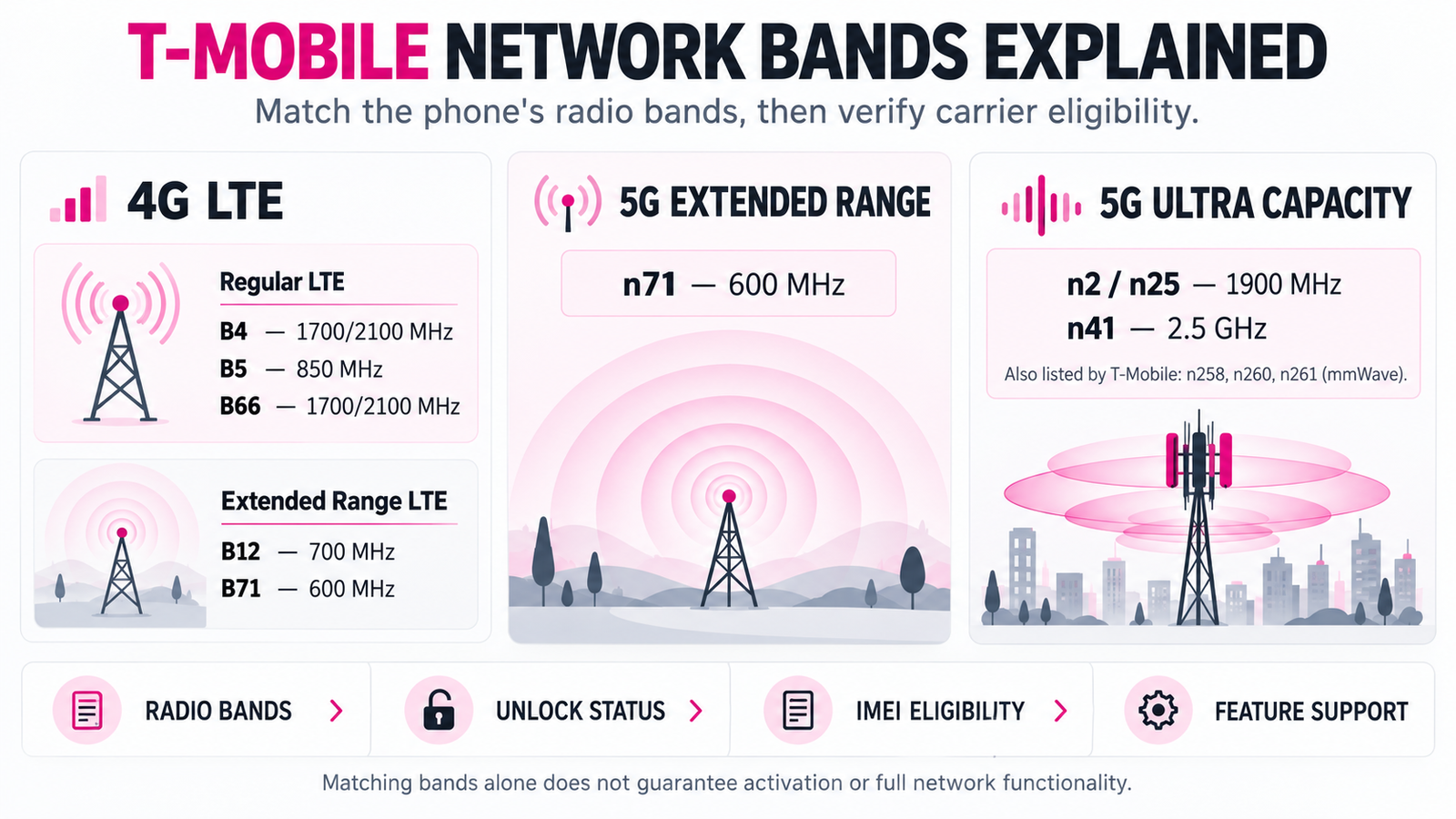
Before you switch or buy, confirm four things:
- Unlock status: The device must be free to use another carrier’s service.
- Network bands: Its exact hardware variant must support suitable T-Mobile LTE and 5G frequencies.
- IMEI eligibility: T-Mobile must accept the specific device for activation.
- Features: Confirm calling, SIM or eSIM activation, and any other services important to you.
Start here: Check your phone with T-Mobile’s official IMEI tool.
What Makes a Phone Compatible With T-Mobile?
Phone compatibility is more complicated than inserting a SIM card and seeing whether signal bars appear. Several independent conditions determine whether a smartphone can use T-Mobile reliably.
1. The phone supports T-Mobile’s network frequencies
Wireless carriers use particular radio frequencies, commonly identified as network bands. A phone’s internal modem and antennas must support the appropriate frequencies and network technologies to communicate with nearby towers.
For example, T-Mobile identifies LTE Band 71 (600 MHz) as part of its Extended Range LTE network, while 5G bands n71 and n41 support different parts of its 5G network. A phone lacking important bands may still connect where other supported frequencies are available, but it can experience coverage or performance limitations.
2. The phone is unlocked
A carrier-locked phone can be restricted to its original wireless provider, even when the hardware supports T-Mobile’s frequencies. Unlocking removes that carrier restriction; it does not add missing network bands.
3. The specific device is eligible for activation
Two phones with similar specifications may have different carrier eligibility because of their model variants, software or device status. This is why T-Mobile recommends checking the actual device’s IMEI.
Hardware support is useful evidence, but T-Mobile’s device eligibility result is the important final activation check.
4. The features you need are supported
Ordinary cellular data, voice calling, eSIM activation, Wi-Fi Calling and other network features do not necessarily share the same compatibility requirements. Software configuration and carrier provisioning can affect which services operate correctly.
T-Mobile’s Bring Your Own Device support guide specifically warns that it cannot guarantee every feature or level of performance on devices originally sold outside its own sales channels.
How to Check if Your Phone Will Work on T-Mobile
You can complete most of the compatibility research without visiting a carrier store. Follow these steps in order, particularly if you are considering a used or international smartphone.
Step 1: Identify the exact phone model
Start with the model identifier, not just the marketing name.
- iPhone: Open Settings > General > About. Find Model Number; on supported iOS versions, tapping the part number reveals the A-number model identifier.
- Samsung and other Android phones: Open Settings > About phone or About device and look for the model number.
- Before purchasing: Ask the retailer or seller for the exact manufacturer model number and original sales region.
For example, a U.S. Galaxy S25 and a Galaxy S25 originally marketed in another country may have different published LTE band support, despite sharing the same product name.
Step 2: Confirm the phone is unlocked
For many iPhones, Settings > General > About includes a Carrier Lock status. A display reading “No SIM restrictions” generally indicates that the device is not carrier-locked.
On Android, the method varies by manufacturer and original carrier. If the status is uncertain, contact the carrier that sold the phone or request confirmation from the seller before purchasing.
Do not assume that an advertised “unlocked” phone has been independently verified.
Step 3: Compare its LTE and 5G bands
Look up the exact model on the manufacturer’s official specifications page. Compare those bands with T-Mobile’s published network frequencies.
Pay particular attention to Extended Range LTE B12/B71, Extended Range 5G n71 and Ultra Capacity 5G n41. The presence of these bands can be informative, but the combination of supported technologies, local network deployment and device eligibility matters more than checking a single number.
Step 4: Check the IMEI directly with T-Mobile
- Open your phone’s dialer and enter *#06# to display its IMEI.
- Visit T-Mobile’s official Bring Your Own Phone page.
- Enter the IMEI into the compatibility checker.
- Review the device compatibility result and any additional unlock or activation requirements.
- If the result is uncertain, contact T-Mobile to verify the specific device.
Keep your IMEI private. Enter it into the official checker rather than posting it in public comments, forums or social media discussions.
Step 5: Check coverage and required features
Even an eligible phone may not receive every available network service in every location. Use T-Mobile’s coverage map to investigate your home, workplace and frequently visited areas.
If you rely on Wi-Fi Calling, eSIM or another particular feature, confirm that separately before transferring your main number.
Buying tip: For a used phone, ask whether the device is paid off, unlocked and eligible for activation. An attractive price is not useful if the carrier cannot activate it.
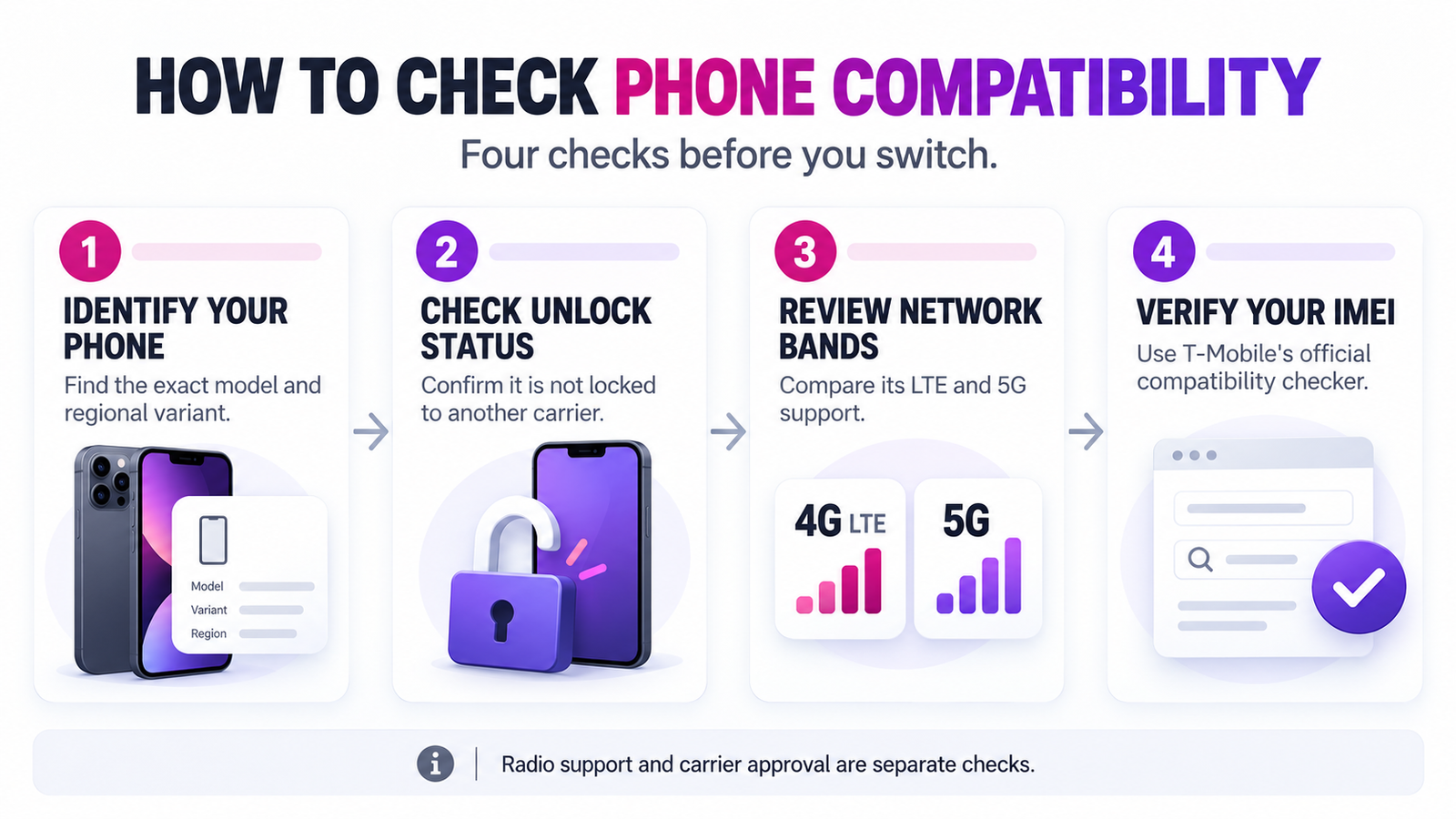
T-Mobile Network Bands: Which LTE and 5G Frequencies Matter?
T-Mobile operates multiple network layers. Some frequencies help provide broader coverage, while others contribute additional capacity where deployed. A compatible smartphone may use different combinations depending on location and network conditions.
The following table follows the frequencies identified on T-Mobile’s official network support page, reviewed October 8, 2026.
| Network | Bands | Frequencies | What it means for buyers |
|---|---|---|---|
| 4G LTE | B4, B66 | 1700/2100 MHz | Relevant LTE connectivity, where those bands are deployed. |
| 4G LTE | B5 | 850 MHz | Another listed LTE frequency; local availability varies. |
| Extended Range LTE | B12 | 700 MHz | Important to consider when evaluating broader LTE coverage. |
| Extended Range LTE | B71 | 600 MHz | Worth checking carefully, especially on international models. |
| Extended Range 5G | n71 | 600 MHz | Supports T-Mobile’s broad-coverage 5G layer. |
| Ultra Capacity 5G | n2, n25 | 1900 MHz | Part of T-Mobile’s listed higher-capacity 5G spectrum. |
| Ultra Capacity 5G | n41 | 2.5 GHz | A major mid-band consideration for T-Mobile 5G. |
| Ultra Capacity 5G (mmWave) | n258, n260, n261 | 24, 39 and 28 GHz | Additional high-frequency 5G bands listed by T-Mobile; coverage and device support are more specialized. |
Source and scope: T-Mobile’s published frequency table also lists Band 2 under its 2G network. This table reflects the official technology categories used in that source; it is not an exhaustive inventory of every network deployment, carrier aggregation combination or future spectrum change.
Why are LTE Bands 12 and 71 important?
B12 and B71 are part of T-Mobile’s Extended Range LTE offering. These lower-frequency bands can help extend usable coverage compared with relying exclusively on higher-frequency deployments, although actual reception depends on the surrounding environment and local network design.
A smartphone missing B71 is not automatically unusable. It may connect over other LTE bands where available. However, buyers should not assume it will offer the same coverage experience as a phone supporting the fuller range of locally deployed bands.
What is the difference between 5G n71 and n41?
n71 is associated with T-Mobile’s low-band Extended Range 5G layer. n41 operates at 2.5 GHz and is an important part of its Ultra Capacity 5G network.
These bands address different network needs. A device supporting n41 but not n71 may access some 5G deployments without having access to the carrier’s n71-based Extended Range layer.
Does a phone need every T-Mobile band?
No. Not every frequency is used at every location, and a phone does not need every listed band to connect somewhere on the network.
But that does not make missing frequencies irrelevant. A device supporting only a narrow selection of bands may work in one neighborhood and perform poorly in another.
Practical rule: Compare the actual model’s bands, check the coverage in your area and use T-Mobile’s IMEI result to verify eligibility. Treat band matching as part of the evidence, not a final compatibility certificate.
T-Mobile Compatible Phones List: Apple, Samsung, Pixel, Motorola, OnePlus and Xiaomi
There is no reliable way to approve every handset sold under a brand name without checking its specific variant. The examples below instead show what can be established from published manufacturer specifications.
The status descriptions are deliberately conservative. “Radio bands verified” means the manufacturer’s published specifications were checked; it does not mean the device’s IMEI has passed T-Mobile activation.
| Phone / variant | LTE band evidence | 5G band evidence | Important limitation | Verification status |
|---|---|---|---|---|
| Apple iPhone 16, U.S. model A3081 | B12 and B71 listed; B4/B66 also listed | n71, n41 and n25 listed | Verify unlock and eSIM activation eligibility | Apple radio specs verified; IMEI not checked |
| Samsung Galaxy S25, U.S. listing SM-S931UZSEXAA | B12, B71, B4 and B66 listed | n71, n41 and n25 listed | Other regional Galaxy S25 variants differ | Samsung U.S. radio specs verified; IMEI not checked |
| Google Pixel 9, U.S. model G2YBB | B12, B71, B4 and B66 listed | n71, n41 and n25 listed | Check carrier lock and device eligibility | Google radio specs verified; IMEI not checked |
| Motorola moto g 5G (2024), U.S. support specification | B12, B71, B4 and B66 listed | n71, n41 and n25 listed | Confirm the purchased model matches the U.S. specification | U.S. support-page bands verified; individual SKU/IMEI not checked |
| OnePlus 12R, U.S. specification | B12, B71, B4 and B66 listed | n71, n41 and n25 listed | Carrier software and feature support require confirmation | OnePlus U.S. radio specs verified; IMEI not checked |
| Samsung Galaxy S25, Pakistan-market SM-S931B listing | B12/B66 listed; B71 not listed | n71 and n41 listed | LTE B71 differs from the U.S. listing | Samsung regional specs verified; IMEI not checked |
| Xiaomi 14, Xiaomi Pakistan specification | B12/B66 listed; B71 not listed | n41/n25 listed; n71 not listed | Missing listed Extended Range bands; exact SKU unspecified | Regional band list verified; exact SKU and IMEI not confirmed |
Verification method: Manufacturer specification comparison against T-Mobile’s official network frequency list, as of October 8, 2026. An unlisted band means it does not appear in the cited regional specifications; it is not a substitute for device-specific testing or carrier confirmation.
Apple iPhones on T-Mobile
U.S.-market iPhones are useful candidates to investigate because Apple publishes detailed radio specifications by model. For example, Apple’s iPhone 16 technical specifications identify U.S. model A3081 with LTE B12/B71 and 5G n71/n41, alongside other supported bands.
That provides strong evidence of relevant radio support. It does not prove that every secondhand or carrier-locked iPhone 16 can be activated immediately.
Also check the SIM arrangement. U.S.-market iPhone 16 models use eSIM rather than a traditional physical SIM tray, so activation through a supported eSIM process is important.
Older iPhones need individual checks, particularly when you want 5G instead of LTE-only service.
Samsung Galaxy phones on T-Mobile
Samsung’s U.S. Galaxy S25 listing includes LTE B71 and 5G n71/n41, but the manufacturer’s Pakistan-market Galaxy S25 specifications do not list LTE B71.
This is a useful real-world illustration: the Galaxy S25 name alone is not enough to establish identical network coverage capabilities across regional versions.
Compare Samsung’s U.S. Galaxy S25 specifications with the appropriate regional specification page before making a purchase.
You can also explore the Galaxy S25 specifications on PhonicSpecs or browse the Samsung phone catalog to compare models. Use the manufacturer’s regional documentation for exact U.S. band verification.
Google Pixel phones on T-Mobile
Google provides detailed radio specifications for its Pixel variants. For example, the U.S. Pixel 9 model G2YBB lists LTE B71 and 5G n71/n41, making it a relevant candidate for T-Mobile network-band evaluation.
Check Google’s official Pixel hardware specifications for the exact regional model rather than relying only on a general retail description.
For other buying considerations, see the Google Pixel 9 overview on PhonicSpecs.
Motorola phones on T-Mobile
Motorola’s U.S. support specifications for the moto g 5G (2024) list LTE B12/B71 and 5G n71/n41 among the supported frequencies.
That demonstrates why buyers should examine the actual model rather than assuming that only expensive flagship phones can support important T-Mobile frequencies.
However, Motorola sells different products and configurations across markets. Confirm the precise model and official technical specifications before purchasing.
OnePlus phones on T-Mobile
OnePlus offers U.S.-market phones with documented support for important T-Mobile bands. For example, the U.S. OnePlus 12R specification lists LTE B71, 5G n71 and n41.
The same brand also sells phones in international markets, where supported frequencies and carrier-related features may differ. This matters when buying imported OnePlus hardware through third-party sellers.
Review the OnePlus 12R specifications and features on PhonicSpecs, then confirm the regional model and IMEI before switching.
Will Xiaomi phones work on T-Mobile?
Some Xiaomi phones support portions of T-Mobile’s radio network, but that does not establish complete compatibility.
For example, Xiaomi’s published Pakistan-market Xiaomi 14 specifications include LTE B12 and B66 and 5G n41, but they do not list LTE B71 or 5G n71.
Consequently, a buyer cannot assume that this Xiaomi configuration will deliver the same Extended Range network experience as one of the U.S. variants in the comparison table.
Even where radio frequencies overlap, activation and carrier-specific features remain unconfirmed without the official eligibility check.
Browse the Xiaomi 14 phone overview and other Xiaomi models on PhonicSpecs for general device research, but verify the exact regional specifications independently.
Do Unlocked Phones Work on T-Mobile?
Yes, many unlocked phones can work on T-Mobile, but unlocking alone does not guarantee compatibility.
It helps to distinguish three common situations:
| Type of phone | What it means | What you must still check |
|---|---|---|
| U.S. factory-unlocked | Sold without a carrier lock for use with supported networks. | Exact band support, IMEI eligibility and features. |
| Previously carrier-locked, now unlocked | The original network restriction has been removed. | Unlock confirmation, radio compatibility and IMEI status. |
| International unlocked | Not necessarily tied to a wireless carrier, but designed for a particular regional market. | U.S. LTE/5G bands, activation eligibility and carrier services. |
A factory-unlocked U.S. smartphone with suitable frequency support is generally a more straightforward device to evaluate for U.S. network use than an imported variant with uncertain band coverage.
Still, buyers should verify eligibility before spending money. An unlocked phone can have missing bands, limited carrier features or an IMEI-related activation problem.
T-Mobile’s official BYOD eligibility checker is the appropriate next step.
Do International Phones Work on T-Mobile in the United States?
Some international smartphones can connect to T-Mobile, but the experience varies significantly by regional variant.
Manufacturers may configure the same phone family differently for North America, Europe, China, India and other markets. Differences can include:
- Supported LTE frequency bands
- Supported 5G bands and network configurations
- Physical SIM and eSIM functionality
- Firmware and carrier-related features
- Regional software support and warranties
Example: Two Galaxy S25 regional configurations
Samsung’s published U.S. Galaxy S25 specifications include LTE Band 71. The Pakistan-market Galaxy S25 specification cited in this guide does not list LTE Band 71, even though it lists some other relevant T-Mobile bands.
That difference does not prove the imported phone cannot connect. It does show that the buyer should investigate potential LTE coverage limitations rather than assuming both devices behave identically.
Example: Xiaomi 14 and the missing Extended Range bands
The Xiaomi 14 configuration described on Xiaomi’s Pakistan product page lists 5G n41 but not 5G n71. It also lists LTE B12 but not LTE B71.
This is a good example of why “5G supported” is an incomplete buying criterion. The smartphone may have suitable radio support for some T-Mobile frequencies while lacking others that matter in different locations.
Before importing a phone for use on T-Mobile: obtain the exact model identifier, compare its manufacturer-published band list, confirm unlock status and seek device-specific activation confirmation from T-Mobile. If the seller cannot provide the model or eligibility information, treat compatibility as unconfirmed.
Why Does T-Mobile Say a Phone Is Partially Compatible?
A partially compatible device may be usable on the network without accessing the full range of available technologies or frequencies.
According to T-Mobile’s BYOD support documentation, partial compatibility can lead to reduced coverage or slower data speeds compared with devices that support more of its network capabilities.
Common reasons for partial compatibility
- The phone lacks one or more relevant LTE frequencies.
- Its 5G modem does not support some of T-Mobile’s deployed 5G bands.
- The device supports only some of the carrier’s network technologies.
- The phone’s regional hardware or software limits available functionality.
For example, a device with LTE B12 but no listed B71 may have usable service wherever its supported bands are available, but it should not be presumed to offer the same Extended Range LTE experience as a device supporting both.
Should you keep a partially compatible phone?
That depends on where you use the device and what services you need.
If T-Mobile indicates that the phone can be activated, investigate the coverage at your regular locations and clarify any warnings before relying on it as your primary handset.
For an existing device, partial compatibility does not automatically mean replacement is necessary. For a new purchase, however, a similarly priced U.S.-market phone with broader verified network support may represent the less uncertain choice.
Will Every T-Mobile Compatible Phone Support 5G?
No. A phone can be eligible for T-Mobile’s LTE service without supporting 5G.
LTE compatibility and 5G compatibility are separate technical questions. A 4G-only device lacks the hardware required to connect to 5G radio networks, while a 5G smartphone may support only certain 5G frequency bands.
Extended Range 5G versus Ultra Capacity 5G
T-Mobile describes Extended Range 5G as its broad-coverage low-band 5G layer, with n71 identified in its published frequency information.
Ultra Capacity 5G uses other listed spectrum, including n41, to provide additional network capacity and performance where available.
Therefore, checking only that a device advertises “5G” does not establish that it supports both network layers.
Does support for n41 guarantee 5G UC?
No. Although n41 is relevant, actual service depends on local coverage, device configuration, carrier provisioning and supported network combinations.
A 5G icon, 5G UC indicator or advertised modem specification should not be interpreted as a promise of a particular speed everywhere.
For the best chance of broader compatibility, investigate phones with manufacturer-confirmed support for n71 and n41 alongside appropriate LTE bands, then verify the IMEI and coverage with T-Mobile.
What About T-Mobile eSIM, VoLTE and Wi-Fi Calling?
These services deserve separate attention because a phone may support basic network connectivity without supporting every carrier feature in the same way.
eSIM compatibility
eSIM allows certain phones to activate mobile service digitally without inserting a traditional SIM card.
However, an eSIM-capable phone is not necessarily eligible for every carrier’s eSIM activation process. T-Mobile’s BYOD flow may ask for an EID, the identifier associated with the device’s embedded SIM functionality, when it needs additional eSIM verification.
If you intend to activate an eSIM-only phone, confirm that T-Mobile accepts your specific device before starting a number transfer.
VoLTE and voice calls
VoLTE, or Voice over LTE, lets compatible phones make voice calls through the LTE network instead of depending on older cellular voice technologies.
T-Mobile’s official network documentation identifies VoLTE as part of its LTE service. Its BYOD guidance also advises users to determine whether their device supports VoLTE and Extended Range LTE.
When investigating an international or older phone, do not assume that advertised VoLTE hardware support establishes correct calling behavior on T-Mobile.
Wi-Fi Calling
Wi-Fi Calling lets supported devices place calls and send messages through a Wi-Fi connection using the carrier’s telephone service.
T-Mobile’s Wi-Fi Calling documentation requires an active account, a compatible device, appropriate Wi-Fi connectivity and emergency-address setup.
The carrier also cautions that it cannot guarantee Wi-Fi Calling functionality on every independently purchased phone.
What about T-Satellite?
Normal cellular compatibility should not be confused with eligibility for T-Mobile’s satellite-to-mobile service.
T-Satellite has its own device and service requirements. Check T-Mobile’s satellite support information if that functionality matters to you.
Which T-Mobile Phone Should You Choose?
The best choice depends less on the brand name than on your circumstances, the exact device configuration and the risk of discovering a compatibility problem after buying.
| Your situation | Suggested approach | Most important check |
|---|---|---|
| Keeping your current phone | Check eligibility before replacing anything. | Current IMEI, unlock status and local coverage. |
| Buying an unlocked smartphone | Research U.S.-market factory-unlocked variants first. | Exact SKU, supported bands and activation eligibility. |
| Importing an international model | Compare regional radio specifications carefully. | B12/B71, n71/n41, software features and IMEI. |
| Prioritizing reliable 5G access | Look for documented support for multiple relevant T-Mobile 5G and LTE bands. | n71/n41 support, IMEI eligibility and coverage map. |
| Buying an older used phone | Check network eligibility and ongoing software support before comparing prices. | Unlock status, IMEI, available LTE/5G technologies and software updates. |
Don’t buy based on network support alone
Once you have established that a phone is a suitable candidate for T-Mobile, compare the characteristics that affect everyday use: battery capacity, display, camera system, storage, software support and price.
The PhonicSpecs Phone Finder helps narrow down devices by specifications. You can also use the phone comparison interface to evaluate shortlisted models side by side.
Check the selected country or market before comparing prices. Prices displayed for Pakistan, India or another market should not be treated as current U.S. retail prices.
Remember that a general specification comparison is not a substitute for manufacturer-confirmed regional radio bands or T-Mobile’s official activation checker.
Frequently Asked Questions About T-Mobile Compatible Phones
Can I use a Verizon phone on T-Mobile?
Potentially, yes. The Verizon phone needs to be unlocked, support appropriate T-Mobile network technologies and pass the necessary eligibility checks. T-Mobile provides instructions for checking devices brought from Verizon on its official BYOD page. Do not assume compatibility solely because both carriers support 5G.
Can an AT&T phone work on T-Mobile?
Yes, some AT&T phones can work after unlocking, provided the exact device is technically compatible and eligible for T-Mobile activation. Confirm the phone’s unlock status and use T-Mobile’s official IMEI checker before transferring service.
Can a 4G phone work on T-Mobile without 5G?
Yes, an eligible 4G LTE phone can use T-Mobile’s LTE network without 5G hardware. It will not connect to 5G radio services. The phone must still satisfy T-Mobile’s applicable network and activation requirements, including voice-calling support.
Does a compatible IMEI result guarantee every T-Mobile feature?
No. An IMEI eligibility result is important for activation, but it does not establish that every advanced feature, software configuration or network capability will function identically on the device. Check eSIM, VoLTE, Wi-Fi Calling and other essential features separately.
Can I check T-Mobile compatibility without visiting a store?
Yes. Find your phone’s IMEI using *#06# and use T-Mobile’s online compatibility checker. You can also investigate the manufacturer’s network specifications and T-Mobile’s coverage map from home.
What if T-Mobile cannot determine my phone’s compatibility?
Check that the IMEI was entered correctly and that you are checking the intended device or SIM slot. If the tool still cannot confirm eligibility, contact T-Mobile with the exact model information. An unknown result should not be interpreted as approval or rejection without further confirmation.
Can an older Samsung Galaxy or iPhone still work on T-Mobile?
Possibly. Age alone does not establish whether a phone is compatible. However, older models may lack newer LTE or 5G capabilities, have different voice-service support, or no longer receive important software updates. Check the exact model and IMEI before relying on the device.
Does a phone with 5G n41 automatically support T-Mobile’s entire 5G network?
No. n41 is one of T-Mobile’s listed Ultra Capacity 5G bands, but the carrier also uses other 5G frequencies. A phone supporting n41 without n71, for example, does not thereby gain support for n71-based Extended Range 5G. Local coverage and carrier eligibility still matter.
Final Verdict: Check the Exact Phone Before Switching
The most useful T-Mobile compatible phones list is one that helps you make a safe decision about your particular device—not one that assumes every phone from a familiar brand will behave identically.
Manufacturer specifications show that many U.S.-market iPhone, Galaxy, Pixel, Motorola and OnePlus models support important T-Mobile frequencies. They also show why international variants, including some Samsung and Xiaomi configurations, deserve additional scrutiny.
Your next step: Identify the exact model, confirm that it is unlocked, review its LTE and 5G bands, and check its IMEI using T-Mobile’s official compatibility tool.
After verifying compatibility, explore PhonicSpecs’ searchable smartphone database to compare the display, battery, performance, cameras and other features that will help you choose the right phone for your needs.
Sources and Verification
This guide was researched using official carrier documentation and manufacturer specifications available on October 8, 2026.
- T-Mobile — Network Technologies and Frequencies
- T-Mobile — Bring Your Own Phone and IMEI Checker
- T-Mobile — Bring Your Own Device Support Guide
- Apple — iPhone 16 Technical Specifications
- Samsung — Galaxy S25 U.S. Specifications
- Samsung — Galaxy S25 Pakistan-Market Specifications
- Google — Pixel Phone Hardware Specifications
- Motorola — moto g 5G (2024) Specifications
- OnePlus — OnePlus 12R U.S. Specifications
- Xiaomi — Xiaomi 14 Regional Specifications
Editorial verification note: The model comparisons are based on published hardware specifications, not hands-on testing or individual IMEI checks. Radio-band overlap does not guarantee carrier activation, available features, reception, or specific data speeds. Device firmware, regional variants, eligibility policies and network deployments may change. PhonicSpecs is an independent smartphone information website and is not affiliated with T-Mobile.