
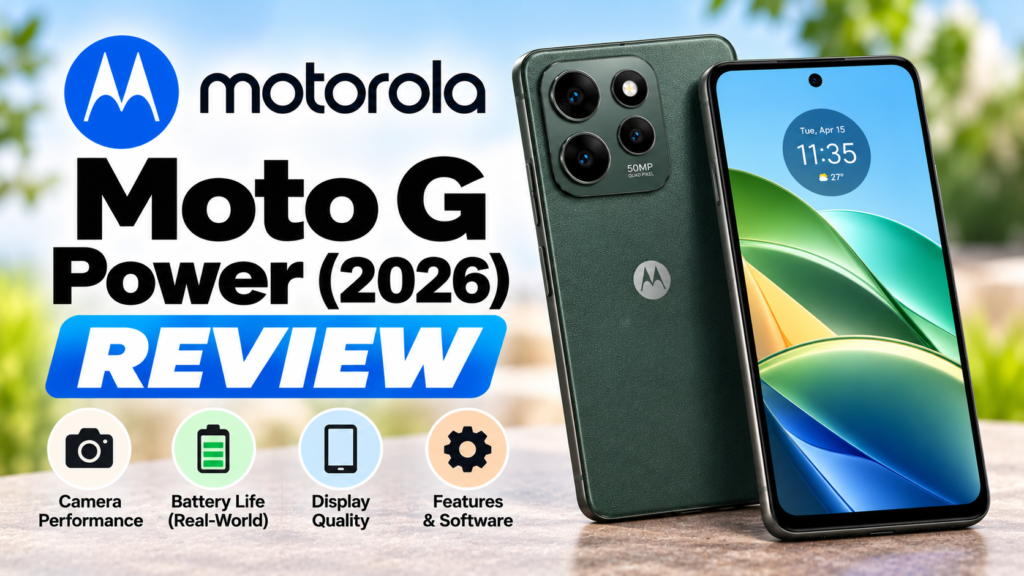
Verdict
A relatively well-rounded tough budget Moto with better display, memory and cameras than the basic G, though the familiar chip and deletion of 2025 wireless charging mean value depends heavily on the selling price.
The Moto G Power (2026) fixes the kind of problems you feel every day: fragile construction and mediocre budget-phone finishing. It brings IP68/IP69 protection, Gorilla Glass 7i, 8GB RAM and a 5,200mAh battery. But “Power” should not be mistaken for a performance upgrade: the Dimensity 6300 carries over, and Motorola removed wireless charging from the 2025 model. That makes the price difference against cheaper Moto G models and discounted predecessors crucial.
Why the Power name should mean durability first
The strongest argument for this model is its combination of IP68 and IP69 ratings, Gorilla Glass 7i and MIL-STD-810H testing claims. That is unusually reassuring construction for a budget-priced phone, although no rating makes a handset immune to damage and protection can deteriorate after repairs. Its grippy finish and 6.8-inch Full HD+ LCD also make it more substantial than the most basic Moto G. If you frequently use a phone outdoors or worry about knocks, the build-related extras are a more defensible reason to pay extra than benchmark figures.
Battery: large capacity, but check expectations
Motorola specifies a 5,200mAh battery and 30W wired charging. Independent publications recorded good endurance, but performance varied by test and some cheaper Moto G siblings also lasted very well. Do not interpret the name “Power” as proof that this is the longest-lasting Moto in every workload. The current model also lacks wireless charging. That omission matters because the Moto G Power (2025) offered it, so wireless-charging users should compare both generations and their current prices rather than blindly buying the newer one.
Screen and daily performance
The 6.8-inch Full HD+ LCD refreshes at up to 120Hz and is sharp enough for text and streaming. With 8GB RAM, the phone has more physical memory than the base Moto G (2026), making app switching more comfortable. However, the Dimensity 6300 remains a modest processor, and independent reviewers found little improvement in benchmarks over the previous generation. This is fine for messaging, video calls and navigation, but buyers spending close to midrange money on gaming should compare alternatives with faster chips and stronger update commitments.
The cameras are usable without pretending to be flagship
Motorola’s 50MP main camera is supplemented by an 8MP ultrawide that can provide a useful wider field of view and macro capability. The 32MP selfie is a welcome spec for video calling. However, these are still budget camera modules; there is no dedicated optical telephoto lens. Independent reviews found the ultrawide useful for certain scenes but did not position this phone as a leading low-light camera. Judge image quality by actual samples in comparable lighting, not the number of round modules on the back.
Moto G Power 2026 vs 2025
The 2026 version offers improved protective materials and a 5,200mAh rated battery, but keeps the Dimensity 6300 class and removes wireless charging. The 2025 model may therefore be the better value if discounted heavily and its wireless charging matters to you. The new 32MP selfie and IP durability enhancements are legitimate upsides, though not everyone will notice them. Before purchasing, compare software-support expiry, exact condition, return policy and after-sale warranty: year-on-year differences are less useful than the total cost and whether your chosen features are present.
US networks, T-Mobile and Pakistan imports
Motorola documents extensive US LTE and 5G band support and dual-SIM options in its support specifications. Still, exact SKU, IMEI eligibility, carrier lock and VoLTE provisioning must be checked using the operator’s official tools. T-Mobile 5G reception is not guaranteed solely by the presence of a 5G logo. Buyers in Pakistan should also avoid assuming this US variant has an official local price, warranty or PTA registration. Those are separate per-device and per-market questions, not generic hardware specifications.
What a buyer gains by moving from Moto G to Power
Both 2026 models retain a Dimensity 6300 and 5,200mAh battery. Power’s real differentiators are 8GB physical RAM versus 4GB, a Full HD+ rather than HD-class display, a useful ultrawide camera and proper IP68/IP69 protection. These are significant daily improvements for people who keep multiple apps open, read lots of text or use a phone in demanding environments; they are not an automatic speed upgrade for intensive games.
Motorola’s US support schedule currently targets January 2029 for the final security updates. Check the full selling price and whether a discounted 2025 Power better meets your needs, particularly if wireless charging is important.
Sources
Pros & Cons
Pros
- IP68/IP69 and Gorilla Glass 7i
- 6.8-inch 120Hz Full HD+ screen
- 5200mAh battery and 8GB RAM
- Ultrawide camera, headphone jack and microSD
Cons
- No wireless charging unlike 2025
- Dimensity 6300 is not a speed upgrade
- Limited OS and security support
- Not the best value for every battery buyer
Frequently Asked Questions
Does Moto G Power (2026) have wireless charging?
No. Unlike the Moto G Power (2025), the 2026 documented US model does not offer wireless charging; it supports up to 30W wired charging.
What is better on Power (2026) than regular Moto G (2026)?
The Power has 8GB physical RAM instead of 4GB, a higher-resolution Full HD+ display, an ultrawide camera and IP68/IP69 ratings. Both use Dimensity 6300 and a 5,200mAh battery.
How long will Moto G Power (2026) get security updates?
Motorola’s US support page currently lists January 2029 as the security-update end date. Verify any carrier or regional variant separately.