Yes, some Xiaomi phones can work on T-Mobile in the United States, but compatibility depends on the exact model, regional version, supported network bands and carrier activation eligibility. Certain Xiaomi phones support important T-Mobile 4G LTE and 5G frequencies, while others lack bands needed for broader coverage.
For example, Xiaomi’s published global Xiaomi 15 Ultra specifications include LTE Band 71 and 5G n71, but the global Xiaomi 15 and Xiaomi 14 specifications do not list those frequencies. All three list 5G n41. That difference matters because T-Mobile uses n71 for Extended Range 5G and n41 for Ultra Capacity 5G.
However, supporting the right frequencies does not automatically guarantee activation, voice calling, Wi-Fi Calling or every network feature. Before using a Xiaomi, Redmi or POCO phone on T-Mobile, you should also check its IMEI with the carrier.
Quick answer: Xiaomi and T-Mobile compatibility
- 4G LTE: Several Xiaomi models support some of T-Mobile’s LTE bands, including B4, B12 and B66.
- 5G: Some support n41, but not all support n71.
- Band 71: The global Xiaomi 15 Ultra specification lists LTE B71 and 5G n71. Many other Xiaomi-family configurations do not.
- Activation: T-Mobile must confirm eligibility for the actual device.
- Best next step: Compare your exact model’s published bands and use T-Mobile’s official IMEI checker.
Check your Xiaomi phone with T-Mobile’s official compatibility tool.
Can Xiaomi Phones Work on T-Mobile in the USA?
Some Xiaomi smartphones have radio hardware that overlaps with T-Mobile’s network frequencies. This means they are technically capable of connecting to certain LTE or 5G network layers where those frequencies are deployed.
That is different from saying every Xiaomi model is fully compatible.
To evaluate a particular handset, distinguish four separate requirements:
- Radio compatibility: Does the phone support the appropriate LTE and 5G bands?
- Unlock status: Is the device free of restrictions imposed by another carrier?
- Activation eligibility: Will T-Mobile accept the phone’s actual IMEI?
- Feature support: Will voice calls, mobile data, messaging and required carrier services work correctly?
A Xiaomi device might satisfy one requirement but not another.
For example, a phone may support LTE B66 and 5G n41 but lack LTE B71 and 5G n71. It may connect in some locations while offering less complete coverage than another model.
Likewise, a device with broad radio-band support can still require additional checks for calling, activation or carrier-specific services.
Does T-Mobile officially guarantee Xiaomi compatibility?
T-Mobile’s Bring Your Own Device documentation cautions that it cannot guarantee the performance or functionality of handsets not originally sold through T-Mobile or its authorized dealers.
The carrier recommends checking the specific device through its IMEI compatibility tool.
Therefore, this article does not classify any Xiaomi model as officially approved based solely on its published specifications. Instead, it compares manufacturer-confirmed hardware capabilities and identifies what needs further verification.
Which T-Mobile 4G LTE and 5G Bands Matter for Xiaomi Phones?
Network bands represent frequency ranges used by cellular networks. A smartphone must support the applicable radio technology and frequency to communicate with a network operating on that band.
T-Mobile publishes the technologies and frequencies it operates on its official network information page.
| Network | Bands | Frequency | Relevance for Xiaomi buyers |
|---|---|---|---|
| 4G LTE | B4, B66 | 1700/2100 MHz | Commonly listed on international Xiaomi specifications; useful where deployed. |
| 4G LTE | B5 | 850 MHz | Another T-Mobile LTE frequency to compare. |
| Extended Range LTE | B12 | 700 MHz | Important to investigate for broader LTE coverage. |
| Extended Range LTE | B71 | 600 MHz | Frequently missing from some international Xiaomi configurations. |
| Extended Range 5G | n71 | 600 MHz | Relevant to T-Mobile’s broad-coverage 5G layer. |
| Ultra Capacity 5G | n2, n25 | 1900 MHz | Additional listed 5G frequencies. |
| Ultra Capacity 5G | n41 | 2.5 GHz | Major mid-band 5G frequency listed by many Xiaomi models. |
Source: T-Mobile’s official network frequency documentation, reviewed October 15, 2026. The carrier also lists mmWave 5G bands n258, n260 and n261. This table is a practical selection of relevant frequencies, not a complete inventory of every network deployment.
Why is LTE Band 71 important?
LTE B71 operates in the 600 MHz frequency range and is part of T-Mobile’s Extended Range LTE network.
Lower-frequency radio signals can offer useful coverage characteristics, including wider reach and improved penetration through some obstacles, although actual reception depends on local deployment, terrain, building materials and other factors.
A phone without B71 may still work through other LTE frequencies. However, buyers should not assume it can access every location where T-Mobile uses B71.
This makes B71 worth investigating when buying an international Xiaomi device for everyday use across the United States.
What is the difference between 5G n71 and n41?
n71 is T-Mobile’s listed 600 MHz Extended Range 5G band. It is particularly relevant when evaluating access to the carrier’s broad-coverage 5G network.
n41 operates at 2.5 GHz and is part of T-Mobile’s Ultra Capacity 5G offering.
These are different network layers. Supporting n41 does not automatically mean a phone supports n71.
For example, Xiaomi’s published global Xiaomi 15 and Xiaomi 14 specifications include n41 but do not list n71.
That means their published hardware specifications cannot establish access to T-Mobile’s n71-based Extended Range 5G service.
Does missing B71 or n71 mean no service?
No. Missing one frequency does not automatically prevent every network connection.
A phone might connect through B4, B12, B66 or other supported LTE frequencies where available. It may also have access to particular 5G layers when the appropriate technologies and configurations are supported.
But missing bands increase uncertainty about where the phone will work and how consistently it will perform.
The important distinction is between having some supported bands and having dependable coverage for your actual locations.
Xiaomi T-Mobile Compatibility List: 4G LTE and 5G Bands Compared
Instead of labeling every Xiaomi phone as compatible or incompatible, the following table compares manufacturer-published specifications with four important T-Mobile frequencies.
How to read the table: “Listed” means the band appears in the cited manufacturer’s specifications. “Not listed” means it is absent from that particular published configuration. Neither status determines whether an individual device can be activated on T-Mobile.
| Device / published configuration | LTE B12 | LTE B71 | 5G n71 | 5G n41 | Assessment |
|---|---|---|---|---|---|
| Xiaomi 15 Ultra — global support specification | Listed | Listed | Listed | Listed | Broader relevant band support; activation unverified |
| Xiaomi 15 — global support specification | Listed | Not listed | Not listed | Listed | Some relevant LTE/5G support; Extended Range gaps |
| Xiaomi 14 — global support specification | Listed | Not listed | Not listed | Listed | Some relevant LTE/5G support; Extended Range gaps |
| Xiaomi 14T — global specification | Listed | Not listed | Not listed | Listed | Missing listed 600 MHz Extended Range bands |
| Redmi Note 14 Pro+ 5G — global support specification | Listed | Not listed | Not listed | Listed | Partial band overlap; device eligibility unverified |
| Redmi Note 15 Pro 5G — Saudi-market specification | Listed | Listed | Listed | Listed | Broader band overlap for this region-specific version |
| Redmi Note 15 Pro 5G — Mexico-market specification | Listed | Not listed | Not listed | Listed | Important regional difference from Saudi specification |
| POCO X7 Pro — global support specification | Not listed | Not listed | Not listed | Listed | More limited overlap with selected T-Mobile bands |
Verification: Official Xiaomi product and support specifications reviewed October 15, 2026. This table covers selected frequencies only. Additional radio bands, supported network combinations, firmware, carrier provisioning and IMEI eligibility affect real-world results. No individual phones were activated or tested.
This comparison shows why the word “Xiaomi” alone cannot establish whether a smartphone supports T-Mobile’s Extended Range LTE and 5G networks.
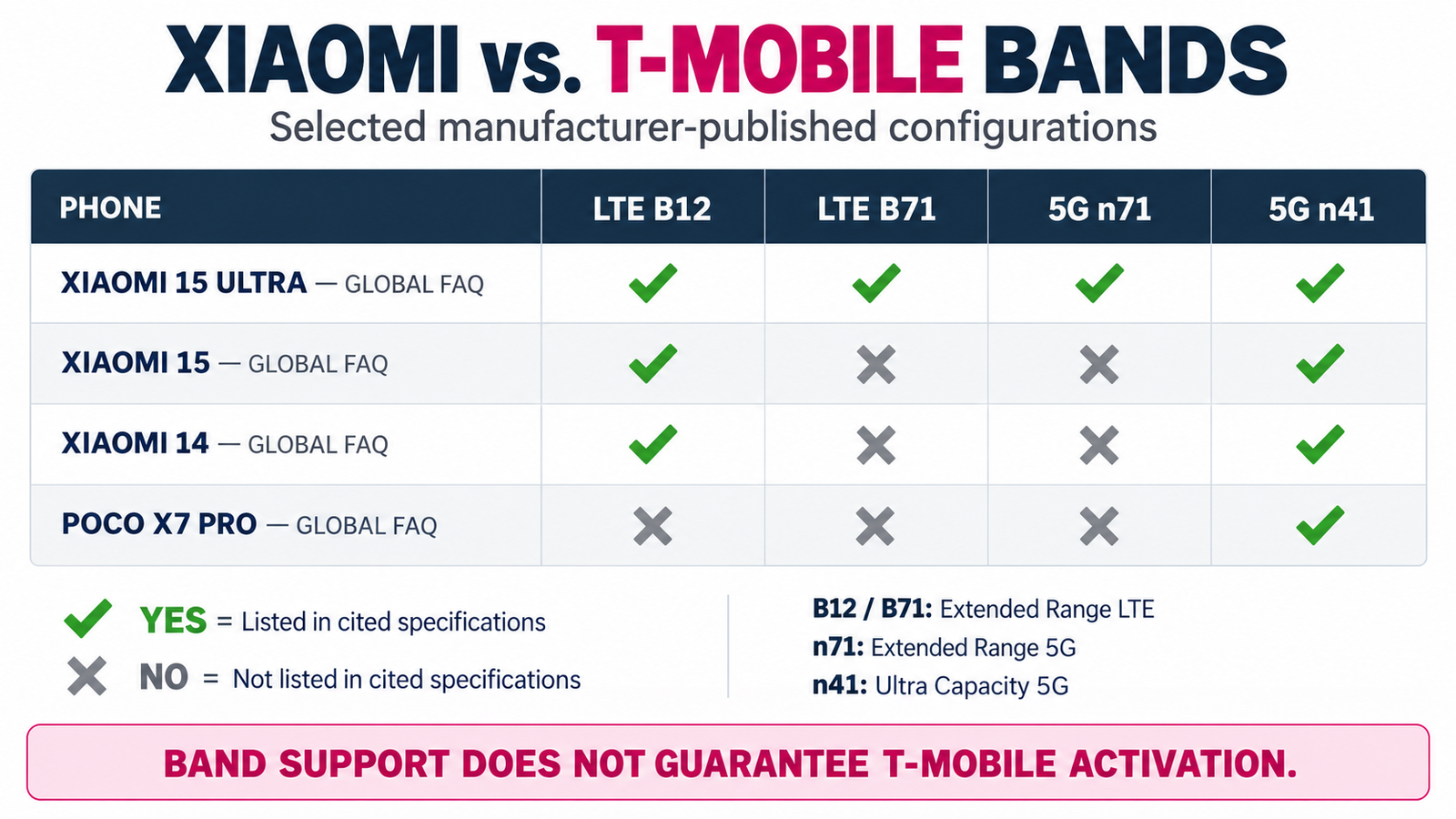
One particularly important finding is that the Xiaomi 15 Ultra lists more of these selected frequencies than the regular Xiaomi 15.
Another is that the Redmi Note 15 Pro 5G has different published B71 and n71 support depending on the regional configuration.
Therefore, buying a phone with the right product name is not enough. The exact market version matters.
Do Popular Xiaomi Phones Work on T-Mobile? Model-by-Model Analysis
Xiaomi 15 Ultra on T-Mobile
The Xiaomi 15 Ultra is one of the more interesting models in this comparison because Xiaomi’s official global support documentation lists:
- LTE B4, B5, B12, B66 and B71
- 5G n25, n41 and n71
- Additional LTE and 5G frequencies for other markets
These bands overlap with important frequencies identified in T-Mobile’s network documentation.
That provides stronger technical evidence for considering the global Xiaomi 15 Ultra than many other Xiaomi configurations that lack B71 and n71.
However, it is not evidence that every Xiaomi 15 Ultra will pass the IMEI checker or support every carrier-specific service.
Different market versions may also have different software or connectivity configurations.
For verification, consult Xiaomi’s official Xiaomi 15 Ultra network-band documentation.
Assessment: The cited global specification has substantial overlap with T-Mobile’s listed LTE and 5G bands. Confirm the exact variant, IMEI and important features before using it as a primary phone.
Xiaomi 15 on T-Mobile
The global Xiaomi 15 specification includes several relevant bands, including LTE B4, B5, B12 and B66, plus 5G n25 and n41.
However, Xiaomi’s global Xiaomi 15 support specification does not list LTE B71 or 5G n71.
This is an important distinction from the Xiaomi 15 Ultra.
The regular Xiaomi 15 may have access to certain T-Mobile network layers where its listed bands and supported configurations are usable, but the specification does not establish support for the carrier’s B71-based LTE or n71-based 5G coverage.
Assessment: Relevant LTE and 5G band support exists, but the missing listed Extended Range frequencies deserve attention. Activation remains unconfirmed.
Xiaomi 14 on T-Mobile
Xiaomi’s global Xiaomi 14 documentation lists LTE B4, B5, B12 and B66, alongside 5G n25 and n41.
It does not list LTE B71 or 5G n71.
This suggests the phone has radio support for some T-Mobile frequencies without covering every important Extended Range band.
The result will depend on the actual model, local coverage, carrier eligibility and supported features.
Compare Xiaomi’s official network information with the Xiaomi 14 specifications on PhonicSpecs.
Assessment: Some relevant 4G/5G bands are documented. Do not assume the phone provides complete T-Mobile Extended Range coverage or guaranteed calling support.
Xiaomi 14T on T-Mobile
The Xiaomi 14T is another example where a 5G-capable international smartphone does not necessarily support all of T-Mobile’s most useful frequencies.
Xiaomi’s global Xiaomi 14T specifications list LTE B12 and B66 and 5G n41, among other frequencies.
However, the published configuration does not list LTE B71 or 5G n71.
The phone may therefore support portions of the network while lacking other relevant frequency capabilities.
Assessment: Investigate carefully, particularly if broad LTE and 5G coverage is a priority.
Do Redmi and POCO Phones Work on T-Mobile?
Redmi and POCO devices belong to Xiaomi’s broader smartphone ecosystem, but they should not be treated as having identical network capabilities to Xiaomi flagship models.
Supported frequencies can differ significantly between product families and even between regional configurations of the same model.
Redmi Note 14 Pro+ 5G
Xiaomi’s global Redmi Note 14 Pro+ 5G support documentation lists LTE B12 and B66, plus 5G n41.
However, it does not list LTE B71 or 5G n71.
That provides evidence of partial frequency overlap, not proof of full T-Mobile coverage.
Buyers should identify the exact configuration before assuming that a global 5G phone will support all the 5G services available on T-Mobile.
Redmi Note 15 Pro 5G: A regional difference worth knowing
The Redmi Note 15 Pro 5G illustrates why regional specifications deserve special attention.
Xiaomi’s Saudi Arabia product specification lists LTE B71 and 5G n71.
However, the Mexico-market specification explicitly identifies those additional bands as applying to the Saudi Arabian version.
Both configurations also list other relevant frequencies, including LTE B12 and 5G n41.
This does not make the Saudi model an officially T-Mobile-approved handset. It demonstrates that the regional specification can materially change the available radio hardware.
Buying lesson: Always investigate the exact market version rather than assuming that all Redmi Note 15 Pro 5G devices have identical B71 and n71 support.
POCO X7 Pro on T-Mobile
The global POCO X7 Pro support specification includes 5G n41 and LTE B4, B5 and B66.
However, it does not list LTE B12, LTE B71 or 5G n71.
These omissions make the model a more uncertain choice for someone relying on T-Mobile across locations that use its Extended Range frequencies.
See Xiaomi’s official POCO X7 Pro network-band information for the published details.
Assessment: The global specification supports some relevant frequencies, but important Extended Range bands are absent from the cited list. Actual activation and performance remain unverified.
Global vs. Chinese Xiaomi Phones: Which Version Is Better for T-Mobile?
When shopping for an imported Xiaomi smartphone, you may encounter descriptions such as “Global Version,” “China Version,” “International Version” or “Global ROM.”
These descriptions are not interchangeable, and they do not establish a complete set of network capabilities by themselves.
What is a global Xiaomi version?
A global or international version generally refers to a product intended for sale outside Xiaomi’s domestic Chinese market.
However, “global” does not mean that the device supports every network frequency used in the United States.
For example, Xiaomi’s global Xiaomi 15 specification does not list LTE B71 or 5G n71.
That is why the exact published network-band list is more useful than the word “global” alone.
What about Chinese-market Xiaomi phones?
Chinese-market versions may have different modem configurations, supported bands, operating-system configurations and service availability.
Before purchasing one for use in the United States, verify the original hardware model and its manufacturer-published specifications.
Also investigate the availability of software features and services that are important to you, such as Google-dependent applications, messaging features and manufacturer support.
These questions should be answered for the actual product and software version rather than generalized across all Chinese-market Xiaomi phones.
Does installing a global ROM add missing network bands?
No. Software changes should not be assumed to add cellular frequency hardware that the device lacks.
A different software configuration may affect settings or feature availability, but it does not guarantee that unsupported radio frequencies become usable.
Likewise, a phone showing a 5G symbol after a software change does not prove support for every T-Mobile 5G band.
Recommendation: Prioritize confirmed hardware specifications and official carrier eligibility over claims that an imported phone can be made fully compatible through software changes.
Will Xiaomi Phones Support T-Mobile Calls, VoLTE, Wi-Fi Calling and eSIM?
Network frequency support is only one part of the experience. A phone may establish mobile data connectivity while other communication features remain uncertain.
VoLTE: Why voice calling needs separate verification
VoLTE, or Voice over LTE, allows supported phones to make cellular voice calls using LTE network technology.
Xiaomi’s specifications and support materials may identify VoLTE capability for a particular handset, but actual operation can depend on carrier support, software configuration and service provisioning.
For example, Xiaomi’s Xiaomi 14 support FAQ identifies VoLTE support while noting that the feature depends on the mobile operator and coverage.
This is important for imported phones. A device should not be considered suitable for regular telephone service merely because its cellular data connects.
Before relying on a Xiaomi phone as your main device, confirm that ordinary incoming and outgoing calls work correctly after legitimate carrier activation.
Does Xiaomi Wi-Fi Calling work on T-Mobile?
Some Xiaomi models support Voice over Wi-Fi, also known as VoWiFi.
For example, Xiaomi confirms VoWiFi support for the Xiaomi 15 Ultra, while noting that the feature also requires compatible carrier service.
T-Mobile’s Wi-Fi Calling documentation describes additional requirements, including an active account, compatible equipment and emergency-address configuration.
Therefore, the appearance of a Wi-Fi Calling setting on a Xiaomi phone does not independently prove that the feature will be provisioned successfully on T-Mobile.
Does Xiaomi eSIM work with T-Mobile?
Some Xiaomi models support eSIM, but availability varies by product, region and carrier.
For example, Xiaomi’s global Xiaomi 14T specifications describe combinations involving physical SIM and eSIM, while cautioning that eSIM availability depends on the region and wireless operator.
If you want to activate a Xiaomi through T-Mobile eSIM, check the specific device’s IMEI and follow the official activation process.
T-Mobile may request the device’s EID for additional eSIM verification.
Do not assume that a model advertised as eSIM-capable can automatically download a T-Mobile eSIM profile.
What about RCS messaging?
RCS messaging is another feature worth checking separately.
Community discussions involving imported Xiaomi phones have reported mixed experiences. Some users describe successful RCS operation, while others have encountered setup or activation problems.
These reports are individual experiences rather than controlled testing, and they do not establish a universal limitation across Xiaomi devices.
If RCS is essential to you, confirm its functionality on the exact phone and software configuration you intend to use.
Does Xiaomi support every T-Mobile feature?
No blanket conclusion is appropriate.
Features such as Wi-Fi Calling, 5G network modes, advanced messaging and satellite-related services can have separate compatibility requirements.
Do not assume that a phone supporting LTE or 5G automatically supports every additional T-Mobile service.
How to Check Whether Your Xiaomi Phone Works on T-Mobile
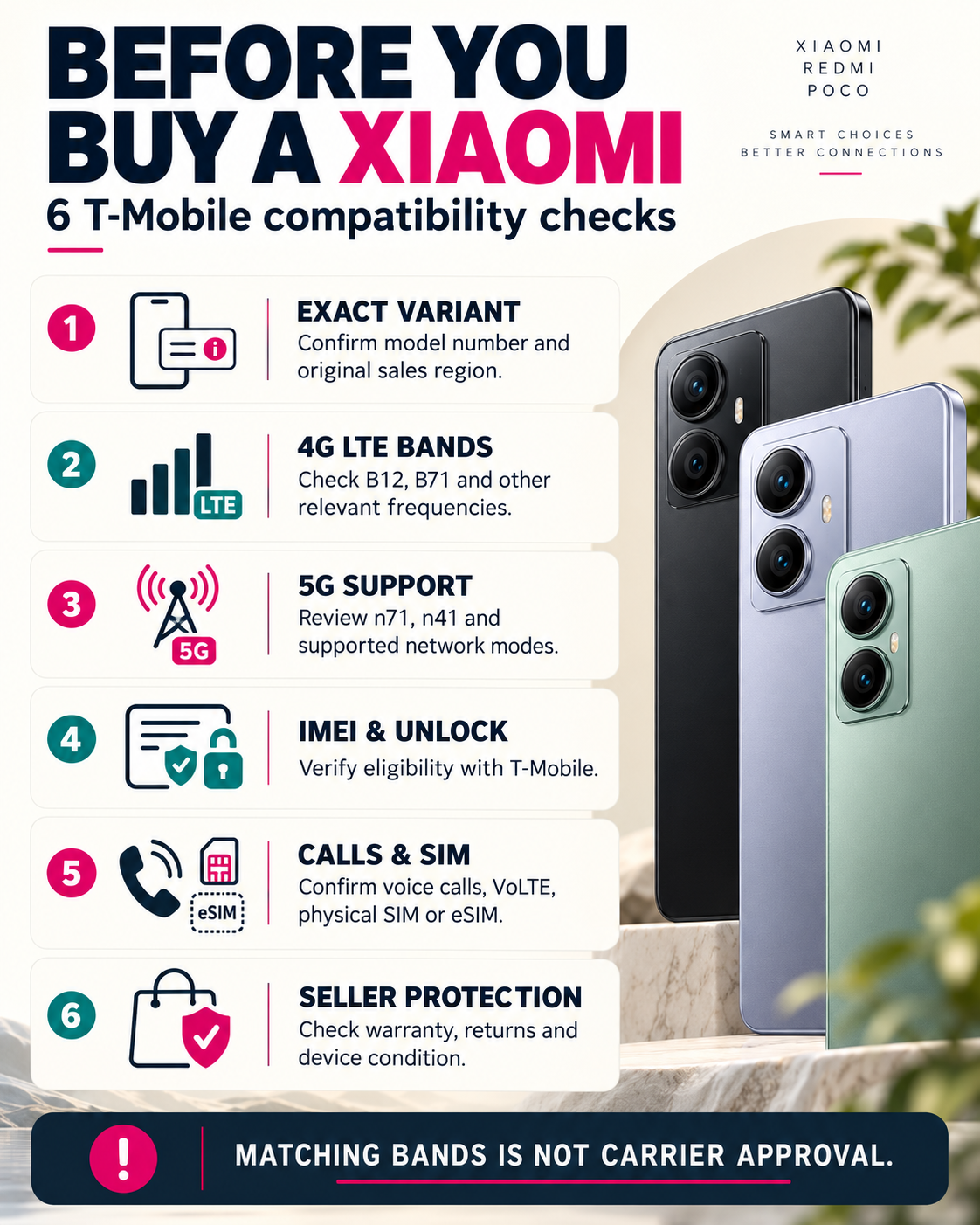
The following process helps separate published hardware support from actual carrier eligibility.
Step 1: Identify your exact Xiaomi model
Open your phone’s Settings and locate the device information section. Depending on the HyperOS or MIUI version, it may be labeled About phone or a similar name.
Record the manufacturer model identifier, device name, software version and original sales region when available.
If you are buying online, ask the seller for the exact model number and regional configuration before payment.
Step 2: Read the manufacturer’s network-band specifications
Find the matching product or support page on Xiaomi’s official website.
Look for the Network, Connectivity or Network Bands section.
Pay attention to whether the specifications describe a global, Chinese, Indian, European or other regional configuration.
Step 3: Compare with T-Mobile’s frequencies
Compare the device’s published LTE and 5G bands with T-Mobile’s official frequency list.
In particular, investigate support for LTE B12/B71 and 5G n71/n41, along with other relevant frequencies.
Also consider whether your specific device supports the network technologies and configurations needed for the service you want.
Step 4: Check the phone’s IMEI with T-Mobile
- Open your Xiaomi’s dialer.
- Enter *#06# to display its IMEI.
- Visit T-Mobile’s official IMEI checker.
- Enter the appropriate IMEI and review the result.
- Check for additional messages about carrier locking, activation and eSIM support.
If the phone has multiple IMEIs, confirm which identifier T-Mobile requires for the intended SIM or eSIM activation.
Keep the full IMEI private and use official verification channels.
For detailed explanations of compatible, partially compatible, blocked and unknown results, see our T-Mobile IMEI Check guide.
Step 5: Check your local coverage
Use T-Mobile’s coverage map to investigate the areas where you expect to use the phone.
Network availability can differ between cities, neighborhoods, buildings and rural locations. A frequency supported by your Xiaomi does not guarantee that the same band will be available everywhere.
Step 6: Confirm essential carrier features
Before relying on the device for everyday service, confirm voice calling, SMS, mobile data, SIM activation and any essential extras such as Wi-Fi Calling or eSIM.
If you have not yet purchased the phone, ask the seller about carrier compatibility, device condition and return eligibility in case activation cannot be completed.
If any of these checks remains unresolved, avoid assuming that the phone will work reliably simply because its specifications mention 4G or 5G.
Common Xiaomi and T-Mobile Compatibility Problems
Not all connection problems have the same cause. Identifying whether the issue involves hardware, activation, coverage or software is essential before deciding what to do next.
Xiaomi shows signal bars but mobile data does not work
Signal bars alone do not establish that mobile data has been correctly activated or configured.
Possible explanations include an inactive SIM, a carrier provisioning issue, unsupported network configurations or incorrect mobile data settings.
First confirm the device’s eligibility and account activation with T-Mobile.
If the carrier confirms that service is active and supported, consult its official BYOD data and APN guidance for appropriate troubleshooting.
Changing APN settings cannot add unsupported LTE or 5G hardware bands.
4G LTE works but 5G does not
A Xiaomi may support suitable LTE frequencies without supporting all of T-Mobile’s 5G bands or network modes.
For example, a phone with n41 but no n71 should not be assumed to have access to the carrier’s entire 5G coverage network.
Check the exact bands, supported 5G modes, local coverage and carrier eligibility before assuming the problem is a defective phone.
Mobile data works but voice calls fail
Data connectivity does not guarantee functional voice service.
Check whether the device has been fully activated for calling, whether VoLTE is supported on the carrier and whether the phone’s software is configured appropriately.
Contact T-Mobile and Xiaomi support if the service remains unavailable.
Do not rely on undocumented software modifications or hidden configuration changes as proof that carrier support can be restored.
IMEI checker says unknown or partially compatible
An unknown result means the checker could not confirm compatibility. It should not automatically be treated as approval or rejection.
Verify the IMEI and exact device variant, then contact T-Mobile if the lookup remains inconclusive.
A partially compatible result suggests that some network technologies or frequencies may be unavailable.
T-Mobile warns that partial compatibility can affect coverage and data performance compared with devices supporting more of its network capabilities.
eSIM or Wi-Fi Calling is unavailable
Some features depend on regional firmware, carrier provisioning and device eligibility.
Confirm that the exact Xiaomi configuration supports the feature and that T-Mobile allows it on the device.
When eSIM activation is unavailable, investigate whether the phone supports an eligible physical SIM method.
Should You Buy a Xiaomi Phone for T-Mobile?
A Xiaomi phone may be worth considering if you want a particular combination of camera hardware, display features, processing performance or other specifications unavailable in your preferred local phone options.
However, buying an imported smartphone specifically for T-Mobile introduces compatibility questions that should be settled before payment.
When a Xiaomi purchase may make sense
A Xiaomi device is a more reasonable candidate when:
- The exact regional model is clearly identified.
- The manufacturer documents suitable LTE and 5G support.
- T-Mobile confirms the actual IMEI is eligible.
- Carrier unlocking and SIM requirements are resolved.
- You can verify essential calling and messaging features.
- The seller offers reasonable return and warranty terms.
The global Xiaomi 15 Ultra, for example, has stronger published support for the selected T-Mobile bands than some other Xiaomi models examined here. That makes it technically interesting, but it still requires the same activation checks.
When another phone may be the safer choice
Consider a different device if the Xiaomi model lacks network bands important to your locations, cannot pass the carrier’s eligibility check, or has unresolved voice-service limitations.
A well-documented smartphone intended for the U.S. market may also be easier to evaluate when you need dependable service and accessible warranty support.
That is especially relevant when a phone will be your only means of communication.
What should you ask an international seller?
Before buying, ask for:
- The exact manufacturer model number.
- The original sales country or region.
- The official LTE and 5G band specifications for that version.
- Confirmation of carrier-unlock status.
- Whether the actual device can be checked for T-Mobile IMEI eligibility.
- The supported physical SIM or eSIM configuration.
- Warranty coverage and return terms if carrier activation fails.
If the listing only states “Global 5G Unlocked” without providing the exact configuration, ask for clarification before ordering.
Compare Xiaomi phones before deciding
Visit the PhonicSpecs Xiaomi phone catalog to explore supported device specifications and compare hardware features.
You can also use the PhonicSpecs Phone Finder to investigate alternative smartphones by specifications.
Remember that prices displayed for Pakistan or another market should not be interpreted as verified U.S. prices.
Use PhonicSpecs for product research and T-Mobile’s official tools for carrier eligibility.
Frequently Asked Questions About Xiaomi and T-Mobile
Does Xiaomi work with T-Mobile in the United States?
Some Xiaomi devices support frequencies used by T-Mobile, so a connection may be possible. However, successful service depends on the exact model, supported network technologies, unlock status, IMEI eligibility and carrier-specific features. Not every Xiaomi phone is equally suitable.
Which Xiaomi phones support T-Mobile Band 71?
Xiaomi’s official global Xiaomi 15 Ultra specification lists LTE B71 and 5G n71. The cited global Xiaomi 15, Xiaomi 14 and Xiaomi 14T specifications do not list those bands. Some Redmi regional configurations, such as the Saudi-market Redmi Note 15 Pro 5G, also list B71 and n71.
Does the Xiaomi 15 Ultra work on T-Mobile 5G?
The global Xiaomi 15 Ultra specification lists important T-Mobile 5G frequencies, including n25, n41 and n71. This is useful evidence of radio compatibility, but actual 5G service, activation and features must still be confirmed for the specific phone.
Does the Xiaomi 15 work on T-Mobile?
The global Xiaomi 15 specification lists LTE B12/B66 and 5G n25/n41, among other frequencies. It does not list LTE B71 or 5G n71. The phone therefore has some relevant radio support but should not be presumed to offer every T-Mobile network layer. IMEI eligibility remains unverified.
Can the Xiaomi 14 use T-Mobile 5G?
The global Xiaomi 14 specifications list 5G n41 and n25, but not n71. Access to specific T-Mobile 5G services depends on network deployment, supported configurations and activation eligibility. Manufacturer band information alone cannot guarantee service.
Do Redmi Note phones work on T-Mobile?
Compatibility varies by model and region. Some Redmi Note configurations list LTE B12 and 5G n41, while selected regional versions list B71 and n71 as well. Identify the exact variant and verify its IMEI with T-Mobile before assuming it will work.
Does the POCO X7 Pro work on T-Mobile?
Xiaomi’s global POCO X7 Pro specification lists LTE B4/B5/B66 and 5G n41, but does not list LTE B12/B71 or 5G n71. This indicates limited overlap with certain important T-Mobile Extended Range bands. Its actual activation eligibility has not been confirmed.
Is a global Xiaomi phone better than a Chinese version for T-Mobile?
It depends on the actual hardware and software configurations. A global model is not automatically compatible with all U.S. frequencies, and a Chinese-market model should not automatically be classified as unusable. Compare the exact manufacturer’s specifications and carrier eligibility for each variant.
Does installing a global ROM make Xiaomi fully compatible?
No. Software changes do not guarantee support for radio frequencies missing from the device’s hardware. They also do not establish carrier approval or access to every network feature.
Can Xiaomi use T-Mobile eSIM?
Some Xiaomi phones have eSIM capabilities, but the availability of eSIM hardware and carrier activation varies by regional model. T-Mobile may require an EID check before confirming eligibility. Verify the actual device through the official activation process.
Does T-Mobile support Xiaomi VoLTE and Wi-Fi Calling?
Support must be assessed for the specific phone and its software configuration. Xiaomi documents VoLTE and VoWiFi capabilities on certain models, but T-Mobile’s provisioning and eligibility requirements remain separate. Confirm both features before relying on the device for essential calling.
Will Xiaomi phones work with Mint Mobile or Metro by T-Mobile?
Using a carrier that operates on T-Mobile’s network does not automatically establish eligibility. Each provider may have its own device activation procedures and feature requirements. Check the exact Xiaomi model with the provider you actually intend to use.
Can a Xiaomi phone have signal but no mobile data?
Yes. Signal reception does not prove that the cellular line is fully activated or that mobile data is configured and supported correctly. Confirm carrier eligibility and account activation first, then follow official troubleshooting guidance.
Is T-Mobile Band 71 necessary for every Xiaomi phone?
No. A Xiaomi phone may connect using other supported frequencies where they are deployed. However, missing LTE B71 or 5G n71 can limit access to portions of T-Mobile’s Extended Range network. Their importance depends on the locations where you need service.
Final Verdict: Can You Use a Xiaomi Phone on T-Mobile?
Some Xiaomi, Redmi and POCO phones have hardware that supports portions of T-Mobile’s 4G LTE and 5G networks, but no brand-wide compatibility guarantee is appropriate.
The differences can be substantial. Xiaomi’s global Xiaomi 15 Ultra specification lists LTE B71 and 5G n71 alongside n41, while several other Xiaomi-family configurations omit the important 600 MHz Extended Range bands.
Regional variants introduce another layer of uncertainty. Even smartphones sharing a product name may have different published frequency support.
Before purchasing or switching, identify the exact model, compare its LTE and 5G bands, confirm unlock status, and use T-Mobile’s official IMEI checker.
For additional help, read our T-Mobile Compatible Phones guide, our IMEI result explanation guide, and our unlocked phone buying guide.
You can also explore Xiaomi smartphone specifications on PhonicSpecs to compare devices before making your decision.
Sources and Verification
This guide is based on official T-Mobile documentation and Xiaomi manufacturer specifications reviewed October 15, 2026.
- T-Mobile — Network Technologies and Frequencies
- T-Mobile — Bring Your Own Phone and IMEI Checker
- T-Mobile — Bring Your Own Device Guide
- T-Mobile — Official Coverage Map
- Xiaomi — Xiaomi 15 Ultra Network Bands
- Xiaomi — Xiaomi 15 Network Bands
- Xiaomi — Xiaomi 14 Technical FAQ
- Xiaomi — Xiaomi 14T Specifications
- Xiaomi — Redmi Note 14 Pro+ 5G Bands
- Xiaomi — Saudi-Market Redmi Note 15 Pro 5G
- Xiaomi — Mexico-Market Redmi Note 15 Pro 5G
- Xiaomi — POCO X7 Pro Network Bands
- Xiaomi — Xiaomi 15 Ultra VoWiFi Support
Editorial verification note: The model comparisons are based on Xiaomi’s published specifications and T-Mobile’s official documentation. No individual IMEIs were submitted, and no hands-on network, speed, reception, calling or activation testing was conducted. A listed radio band is not proof of T-Mobile certification or full service. Actual compatibility can depend on the exact regional variant, software configuration, supported network combinations, device status, carrier policies and local coverage. PhonicSpecs is an independent smartphone information website and is not affiliated with Xiaomi or T-Mobile.